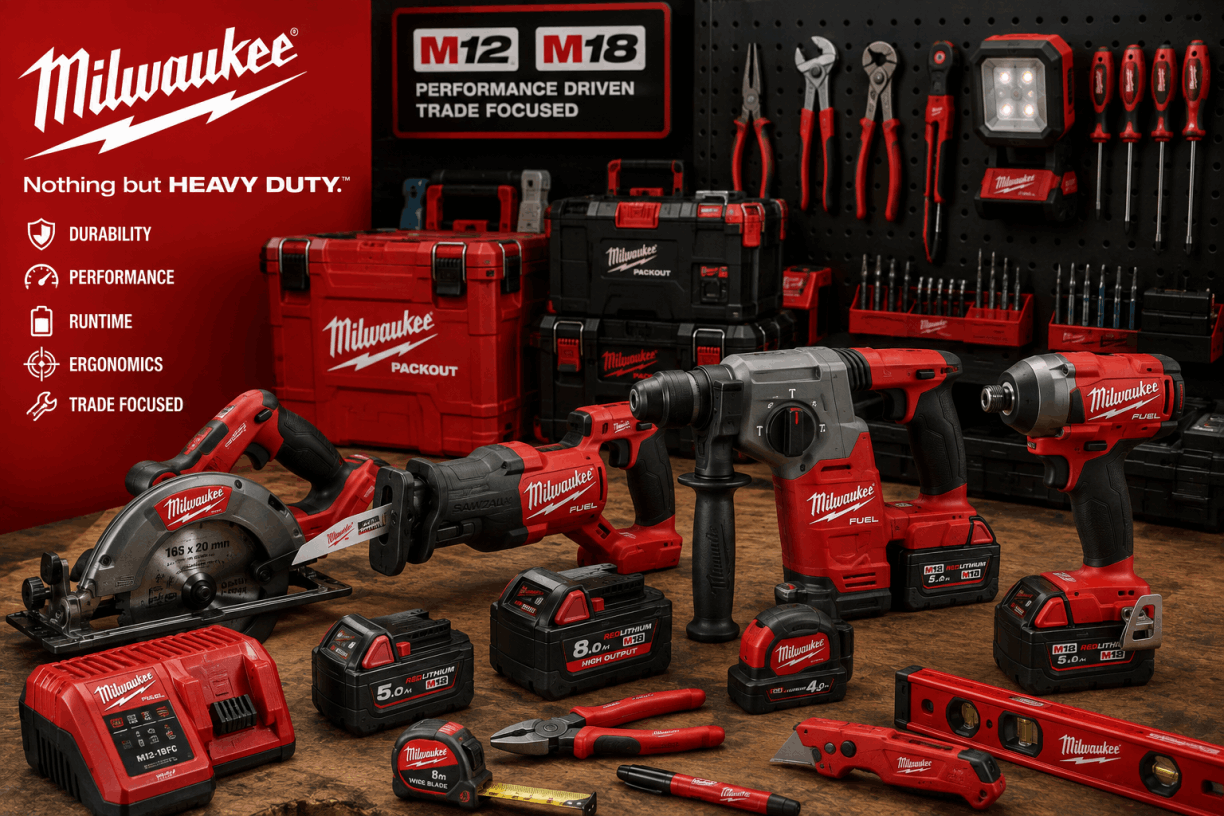
Milwaukee Tools: Choosing the Right Cordless Tools for Professional Trade Work
Professional tradespeople depend on tools that can perform consistently in demanding environments. Construction sites, workshops and maintenance jobs can place significant strain on equipment through dust, vibration, repeated use and changing weather conditions. Choosing the right tools is therefore about more than simply comparing specifications. Reliability, battery compatibility, ergonomics and access to suitable accessories can all influence how useful a tool proves over its working life.
For professionals and serious DIY users considering Milwaukee Tools, one of the main attractions is the ability to build a collection around established cordless battery platforms. Rather than purchasing completely separate batteries and chargers for every tool, compatible equipment can share power sources, making it easier to expand a toolkit as new requirements develop.
Cordless technology has advanced considerably over recent years. Modern lithium-ion batteries can deliver the power required for applications that once depended almost entirely on mains electricity. Drilling, cutting, grinding, fastening and even heavier construction tasks can now be completed using portable equipment without constantly searching for a power socket.
For many users, the starting point is a cordless drill. Drill drivers are suitable for everyday drilling and screwdriving, while combi drills add a hammer function for working with masonry. Choosing between models usually involves considering torque, speed, chuck capacity, weight and the materials being worked with most frequently.
Impact drivers complement cordless drills particularly well. Rather than being primarily designed for drilling holes, impact drivers deliver high rotational force for driving screws, bolts and other fasteners. Their compact design can also make them particularly useful when working between joists, inside cabinets or in other restricted spaces.
Tradespeople who regularly work with larger bolts may require an impact wrench. These tools are commonly associated with automotive work, construction and mechanical maintenance, where significant fastening or removal torque may be needed. Correct socket selection remains essential, particularly because ordinary hand-tool sockets may not be suitable for impact applications.
Circular saws provide another good example of how cordless technology has changed professional working. Modern battery-powered saws allow timber and sheet materials to be cut without running extension cables across the workplace. This can improve mobility while reducing some of the practical difficulties associated with temporary site power.
Reciprocating saws are particularly valuable for demolition and refurbishment. Their long blade movement allows timber, metal pipe, plastic and other materials to be cut in areas where conventional saws may be difficult to position. Selecting the appropriate blade for the material is critical for efficient cutting.
Jigsaws provide greater control when curved or detailed cuts are required. They are commonly used for timber, laminate and sheet materials, although blade selection determines which materials can be cut effectively. Adjustable speed and orbital settings can provide additional control depending on the application.
For masonry work, SDS rotary hammers offer substantially different performance from conventional drills. Their hammering mechanism is designed for drilling into concrete and masonry, while certain models also provide chiselling modes suitable for tasks such as removing tiles or carrying out light demolition.
Angle grinders are another common site tool. They can perform cutting, grinding and surface preparation tasks depending on the accessory fitted. Because grinders operate at high speeds, correct guards, discs and personal protective equipment are particularly important.
Battery selection deserves careful consideration when building a cordless collection. Higher-capacity batteries generally provide longer runtime, but they also increase the weight and physical size of the tool. A large battery may therefore be appropriate for a high-demand saw while a smaller pack could make more sense on a compact drill used overhead.
Battery compatibility can become increasingly valuable as a tool collection grows. Once several compatible batteries and chargers are available, additional bare tools may sometimes be purchased without duplicating power equipment unnecessarily. This can make expanding an existing system more practical.
However, users should always check compatibility rather than assuming that every cordless product from the same manufacturer uses the same battery. Different voltage platforms are often designed for different performance requirements.
Charging strategy also matters to professional users. Having multiple batteries allows one pack to charge while another is being used. This reduces downtime and can make cordless equipment practical throughout a full working day.
Brushless motor technology is another feature commonly encountered in modern professional tools. Brushless motors electronically control power delivery rather than using traditional carbon brushes. Depending on the application, this can contribute to improved efficiency, reduced maintenance and more effective use of battery capacity.
Tool design is not purely about performance. Weight distribution and ergonomics become increasingly important when equipment is used repeatedly. A lighter or better-balanced tool can reduce fatigue, particularly when drilling overhead, installing large quantities of fixings or working in confined areas.
Lighting is often overlooked when building a cordless system. Portable battery-powered work lights can be extremely useful in lofts, plant rooms, unfinished buildings and areas where permanent lighting is unavailable. Using the same battery platform as other equipment can make site lighting particularly convenient.
Storage and transportation also influence productivity. Professional users may need to move dozens of tools, batteries and accessories between a vehicle and worksite every day. Modular storage boxes allow equipment to be organised into separate units while providing protection during transport.
Consumables should be considered alongside the tools themselves. A powerful drill fitted with a worn bit will perform poorly, just as a high-quality saw cannot compensate for an unsuitable blade. Maintaining a supply of appropriate drill bits, blades, discs and driver bits helps equipment perform as intended.
Routine maintenance can extend tool life considerably. Dust should be removed from ventilation areas, moving components should be inspected and damaged accessories replaced promptly. Batteries and chargers should also be stored according to manufacturer guidance and protected from excessive heat, moisture and physical damage.
Power tool safety should never be treated as optional. Eye and hearing protection may be necessary for many tasks, while cutting or grinding certain materials can require appropriate respiratory protection. Guards and other safety components should remain correctly installed and operational.
Users should also consider vibration and noise exposure when tools are used professionally for extended periods. Selecting suitable equipment, following workplace procedures and managing exposure appropriately can be important parts of occupational safety.
For tradespeople, tool purchasing decisions are often best made across an entire system rather than one product at a time. A particularly inexpensive drill may appear attractive, but the calculation changes when future batteries, chargers, saws, grinders and specialist equipment are considered.
It is therefore useful to identify the applications that will account for most of the workload. An electrician, carpenter, plumber and automotive technician may all require cordless equipment, but their ideal tool collections can look very different.
Home users can apply the same principle on a smaller scale. Rather than purchasing a large collection immediately, starting with a versatile drill and adding tools as genuine requirements arise can provide better value and avoid unnecessary equipment.
Ultimately, Milwaukee Tools can form part of a comprehensive cordless system covering drilling, fastening, cutting, grinding, lighting, storage and specialist trade applications. Choosing the right equipment involves considering much more than headline power figures. Battery compatibility, runtime, ergonomics, accessories, storage and the type of work being performed all contribute to building a practical toolkit that can support demanding work for years.